
What Has Changed in Trade in 2026
The trade landscape in 2026 is shaped by a few key shifts, like:- Businesses are entering new international markets faster
- Cross-border transactions involve more structured reviews
- Documentation and financial alignment are in more details
- Trade decisions are becoming more data-oriented
The Growing Role of Structured Trade Finance
Trade finance solutions like DLC (Documentary letter of credit), SBLC (Standby letter of credit), and BG (Bank Guarantee) continue to play a central role in global trade. However, in 2026 their importance has increased because of how they support structured transactions. When used correctly and efficiently, these instruments:- Gives clarity in cross-border coordination
- Offer smoother communication between parties
- Help align financial expectations early
- Allows transactions to move forward with confidence
Traditional vs Modern Trade Approach in 2026
The shift in global trade becomes clearer when comparing older approaches with current practices: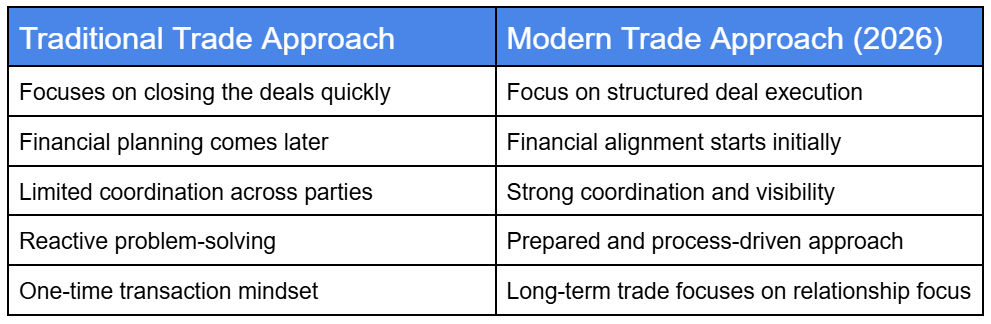 The modern approach is more organized, more predictable, and better suited for global expansion.
Why Import-oriented Businesses Are Adapting Faster
Import-focused businesses are at the center of this change. They manage global sourcing, supplier coordination, and cross-border execution regularly. In 2026, these businesses are focusing more on:- Structured financial planning
- Clear transaction flow
- Reliable trade framework
- Scalable processes for growth
Trade Finance as a Growth Promoter in 2026
In today’s environment, trade finance is not just about supporting a deal, it is about enabling growth. Businesses that adopt structured trade finance approaches are able to:- Enter new markets with confidence
- Build stronger international partnerships
- Handle larger transaction volumes
- Maintain consistency across all the deals